Exceptional AI Leadership: How Modern Leaders Grow in the Age of Intelligent Transformation
Artificial intelligence is no longer a future trend. It’s a present-day force reshaping every industry, from healthcare and logistics to cloud computing and cybersecurity. Yet while AI adoption is widespread, exceptional AI leadership remains scarce. Recent global research shows that almost all organizations now invest in AI, but only about 1% believe they’ve reached real AI maturity. The gap isn’t about access to models or tools. It’s about leaders who can connect AI to strategy, redesign how work gets done, and guide people through a transformation that is as cultural and ethical as it is technical.
For modern leaders, AI is no longer “an IT project.” It is a CEO/C-suite capability that defines competitiveness, resilience, trust, and long-term growth. This article explains what exceptional AI leadership really means, why it’s a CEO/C-suite capability, and how modern leaders can grow into the role, without losing humanity, trust, or control.
What “Exceptional AI Leadership” Really Means
Exceptional AI leadership is more than just managing technology. It’s about guiding a company through uncertainty while blending technical knowledge with the ability to drive real change.
Great AI leaders don’t just adopt new tools; they rethink how the entire business works. They look at products, processes, and customer experiences through an “AI-first” perspective. They know that true success with AI requires both strong technical skills and a solid understanding of how the business operates.
These leaders share a unique set of qualities. They are deeply curious about new technologies and stay ahead of trends. At the same time, they know how to spot real opportunities where AI can create meaningful value. They build strong, cross-functional teams that connect technical possibilities with business goals.
AI leadership also requires being comfortable with constant learning and experimentation. Exceptional leaders understand that AI progress happens step by step through testing, refining, and trying again. They create workplaces where smart risks are encouraged, and failures are seen as lessons, not setbacks.
Most importantly, exceptional AI leaders balance innovation with ethical responsibility. They address issues like bias, privacy, transparency, and job impact, making sure AI benefits people and society.
Why AI Leadership Is Now a CEO/C-Suite Capability

AI governance and priorities have moved decisively to the top of modern organizations. A 2025 Futurum survey shows that CEOs and CTOs alone now control about 44.5% of AI decision-making, with nearly half of all AI decisions flowing through the C-suite.
This shift happened because AI now touches:
⦁ Strategy: what markets to pursue, what products to build, how value is created.
⦁ Risk: privacy, cyber threats, model misuse, bias, and compliance.
⦁ Operations: automation, agentic workflows, human-AI teaming.
⦁ Culture: trust, job evolution, learning norms.
⦁ Customer experience: personalization, support quality, fraud prevention, and decision speed.
And yet leadership readiness hasn’t kept pace. Gartner’s CEO survey found that only 44% of CIOs are considered “AI-savvy” by their CEOs, revealing a real executive confidence gap.
Even more telling: leaders often underestimate employee AI adoption. McKinsey reports that executives think only a small fraction of staff use AI extensively, while actual usage is several times higher, meaning the workforce is moving faster than leadership.
Bottom line: AI is now a leadership problem. Companies that close this gap early gain a durable edge. Those that don’t fall into pilot-purgatory, wasted spend, and security risks.
Graph: AI Adoption vs Leadership Preparedness
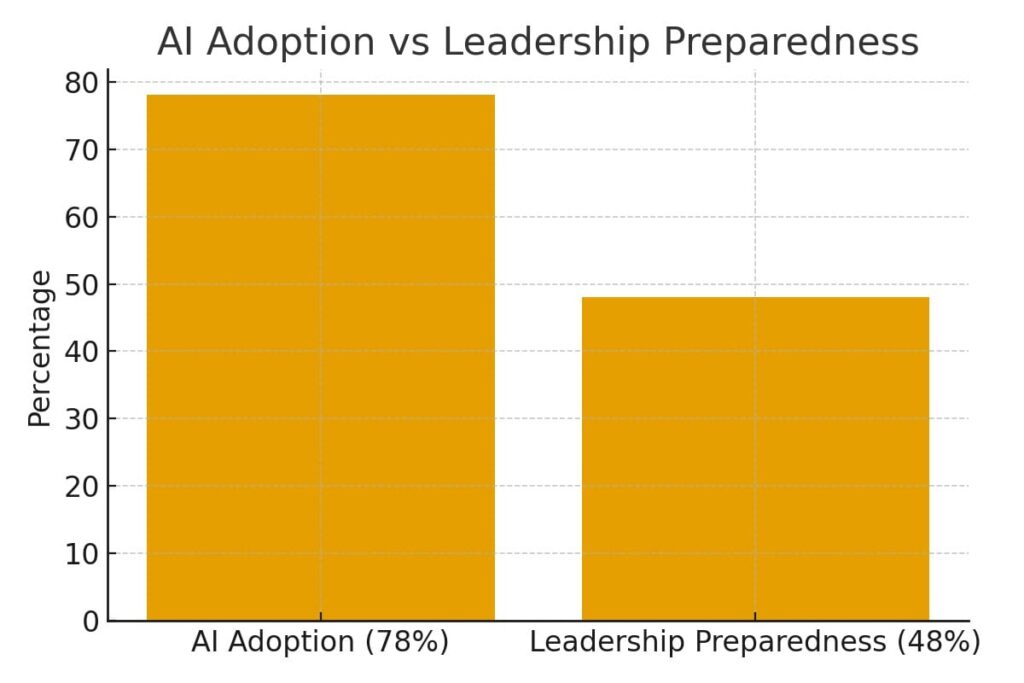
This visual highlights the widening gap between AI implementation (high) and leadership readiness (low). Exceptional AI leadership aims to close this gap before it affects competitiveness.
The Core Traits of Exceptional AI Leaders
The core differentiation of visionaries from followers during intelligent transformation is five traits which make an exceptional leader of AI beyond technical competence.
1) Vision-Driven, Not Tool-Driven
The most important AI leadership starting point is a clear and lasting vision. Unlike a strategy, a vision defines a shared desired future and reinforces it over time. Exceptional AI leaders focus on transforming the business holistically, not just deploying new tools, so every AI initiative maps directly to broader organizational goals.
2) Systems Thinker
Great AI leaders go deep beyond mere technologies and see AI as part of a larger system. They see the feedback loops across People, Processes, Data and Automation using this to get to the root and not just treat the symptoms of the underlying system problems. Systems thinking allows them to design environments where intelligence disperses through the organization, rather than centralizing in one team.
3) Learning Velocity
In AI-driven markets, the new currency of success is how quickly an organization learns and applies new capabilities. Exceptional leaders optimize for the velocity of understanding, not just the speed of execution. High-velocity learning cultures can move employees from novice to conversational proficiency in areas like large language models in roughly two months, creating adaptability at scale.
4) Human-Centered Leadership (EQ + Trust)
While AI can power through data-heavy tasks, Emotional Intelligence is still vital. Leaders with strong EQ connect with teams on deeper levels, guiding them through uncertainty and building trust, capabilities AI lacks. Leadership is emotional labor first, strategic second, as influence always runs through emotions before outcomes.
5) Responsible-by-Design Thinking
Ethics need to be engineered in advance, not bolted on later. Exceptional AI leaders proactively address concerns over bias, privacy, and transparency. They recognize that trust begins with securing data integrity as there must be assurance in the AI outcomes being accurate, timely and secure.
A Practical Framework: The 5 Pillars of Exceptional AI Leadership
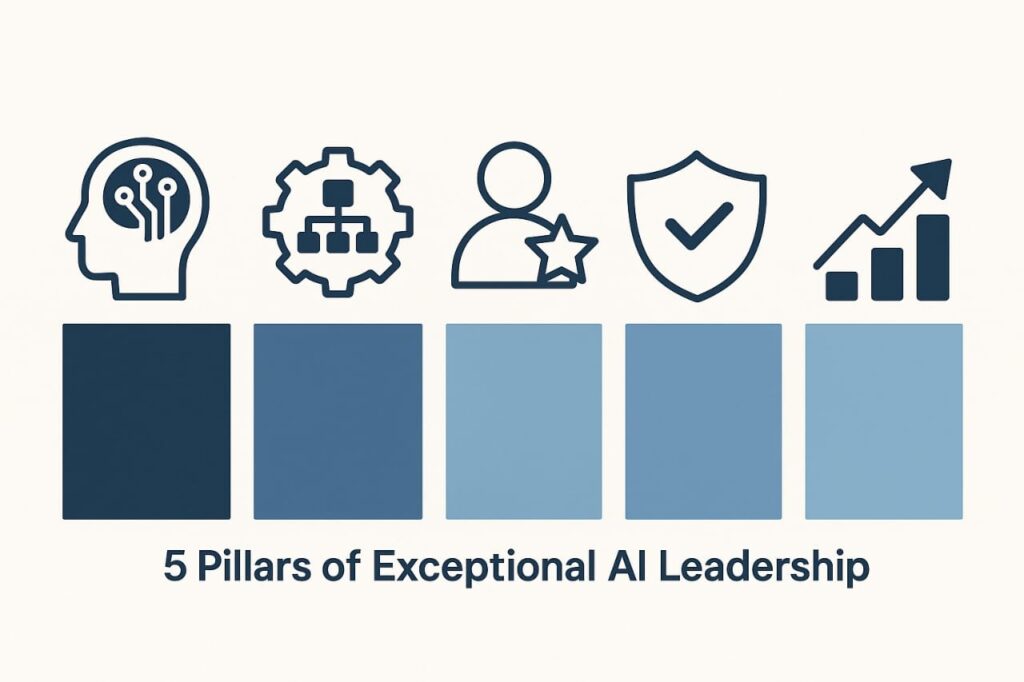
Successful organizations don’t rely on theory. They use a clear, practical structure to guide their AI journey. This framework has five key pillars that help leaders manage AI adoption and governance effectively.
Pillar 1: Strategic AI Clarity
Exceptional leaders align every AI initiative to real business objectives. They distinguish between productivity AI (automation, efficiency) and transformative AI (new business models, reinvention). That distinction matters because each requires a different governance model. Strategic clarity ensures AI investments advance core ambition instead of becoming siloed tech projects.
Pillar 2: AI-Native Operating Model
Competitive advantage comes from redesigning the organization to be AI-first, not AI-assisted. AI-native models embed intelligence into workflows through real-time responsiveness, automation, and continuous learning loops. Operating structures shift away from functional silos toward small, outcome-focused, agentic teams that own end-to-end results.
Pillar 3: Talent and Culture at Scale
With 87% of CEOs expecting roles to be augmented by emerging tech, AI literacy can’t be optional or assumed. Exceptional leaders invest in experiential learning, build knowledge repositories for shared wins, and elevate internal AI champions who model real use cases. They normalize AI as part of daily work and celebrate creative experimentation.
Pillar 4: Responsible Governance and Risk Control
Strong governance protects people and the business without slowing innovation. Frameworks like the NIST AI Risk Management Framework guide responsible development and risk control. Mature AI governance becomes real-time, embedded, and data-driven, with humans retaining final accountability.
Pillar 5: Continuous Value Realization
Value realization represents the end-to-end process of identifying, implementing, monitoring, and evaluating AI investments. Only 6% of organizations report achieving payback from AI investments in under one year. Exceptional leaders implement value blueprints that connect business objectives to specific use cases and clear KPIs. Moreover, they prioritize high-impact, low-effort use cases initially to establish proof of value before scaling.
Table: The 5 Pillars at a Glance
| Pillar | What Great Leaders Do | Example KPIs |
|---|---|---|
| Strategic AI Clarity | Align the AI roadmap to the strategy | % AI projects tied to the top 3 business goals |
| AI-Native Operating Model | Redesign workflows for intelligence | Cycle-time reduction, automation rate |
| Talent & Culture | Train + reward AI usage | AI literacy score, adoption by function |
| Responsible Governance | Embed risk controls early | Bias/opacity incidents, audit pass rate |
| Continuous Value | Measure + optimize outcomes | ROI per use case, time-to-payback |
Common Mistakes That Stop AI Leadership From Becoming Exceptional

Many organizations falter on the path to AI excellence through common pitfalls that hinder progress, waste resources, and create skepticism about AI’s value. Recent findings reveal these critical barriers to exceptional AI leadership.
Mistake 1: Pilots Without Scale Path
Recent MIT research shows a sobering reality: 95% of enterprise AI initiatives demonstrate zero return on investment. Organizations frequently get stuck in pilot mode, lacking clear production deployment strategies. Successful implementations focus on single pain points rather than enterprise-wide transformation, and partner with proven technology providers instead of building everything internally.
Mistake 2: AI as a Cost-Cutting Story Only
About 50-70% of AI budgets flow to sales and marketing pilots, yet the real returns come from less glamorous areas like back-office automation. Leaders who frame AI solely as efficiency-driving miss the bigger opportunity.
The strategic question should shift from “Where can AI reduce costs?” to “Where can AI enable previously impossible growth?”
Mistake 3: Underinvesting in Data Foundations
Data represents ‘layer zero’ of the AI foundation. Organizations often implement AI without addressing fundamental data issues like poor quality, silos, and a lack of standardization. CIOs who develop a competitive advantage through AI focus first on the underlying IT infrastructure.
Mistake 4: Ignoring Ethics Until Late
Leaders who neglect responsible AI governance risk legal implications and negative public perception. Ethical considerations must be built in from the start, not added later, addressing concerns about bias, privacy, and transparency proactively.
Mistake 5: Leaving Middle Managers Behind
Middle managers form the backbone of AI implementation, yet organizations frequently underestimate their importance. They translate ambitious AI visions into practical actions. Without proper support, they face significant challenges, including fear of obsolescence and unclear value propositions.
What Exceptional AI Leadership Looks Like in Practice
Looking at real-world examples, exceptional AI leadership manifests through distinct patterns of action rather than theoretical frameworks alone. Industry leaders who successfully implement AI demonstrate that success requires a deliberate balance of technology, process, and people.
BCG study reveals that most companies are experimenting with AI, but only about 5% are generating value at scale. They do focus on three main ways to create impact. They use AI to improve productivity quickly, to redesign important business functions, and to build new sources of revenue. They don’t treat AI like a small experiment. Instead, they use it to transform work from start to finish.
Successful companies also follow the 10–20–70 rule. Only a small part of AI success comes from the algorithm itself. Some effort goes into data and tools, but most of the work is about people and how they adapt. This is why great AI leadership is still mainly human-focused.
In practice, exemplary leaders model AI utilization personally before expecting adoption, communicate transparently about both successes and challenges, and compassionately address resistance. They actively guide teams through change rather than delegating AI as someone else’s responsibility.
Most importantly, exceptional leaders treat AI like a thinking partner, not a replacement for human judgment. They let AI help with patterns, ideas, and scenarios, but they keep final decisions in human hands, especially when values, long-term goals, and ethics are involved.
The Cybersecurity Reality: Why AI Leadership Must Be Security-First

In the age of intelligent transformation, AI and cybersecurity are inseparable. As AI strengthens business capabilities, it also becomes a target for advanced threats. In cybersecurity, that duality is sharper:
AI helps by:
⦁ Detecting threats faster than humans
⦁ Automating SOC triage
⦁ Predicting breach likelihood
⦁ Analyzing massive logs in seconds
⦁ Improving IAM and anomaly detection
AI risks include:
⦁ Sensitive data leakage through GenAI tools
⦁ Model manipulation or poisoning
⦁ Hallucinated responses used in critical decisions
⦁ Over-automation without accountability
⦁ Increased attack surfaces through AI pipelines
Exceptional AI leaders treat security as a design constraint, not a compliance check. That’s why firms like Optima Technologies occupy a key role: helping leaders deploy AI safely while strengthening resilience.
A Simple 90-Day Roadmap to Build Exceptional AI Leadership
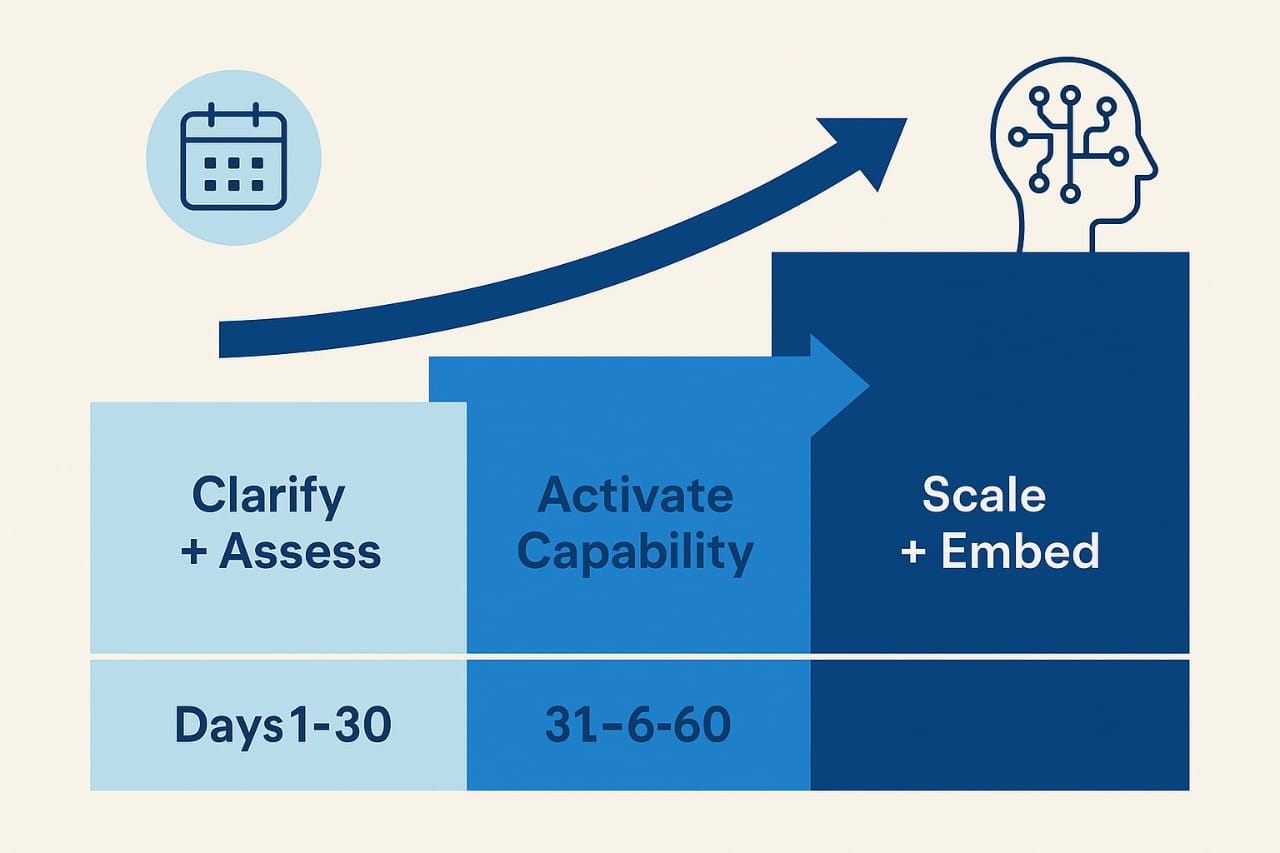
Building exceptional AI leadership requires structured implementation rather than scattered efforts. For organizations seeking to develop AI leadership capabilities efficiently, this practical 90-day roadmap provides a systematic approach to transformation.
Days 1–30: Clarify + Assess
⦁ Define 3–5 strategic AI outcomes (not tools).
⦁ Map critical value streams (where decisions + data flow).
⦁ Audit data quality and security posture.
⦁ Survey AI literacy and sentiment.
⦁ Establish governance baselines using NIST AI RMF concepts.
Deliverables: AI vision statement, priority value streams, risk register, baseline KPIs.
Days 31–60: Activate Capability
⦁ Pick 2–3 high-impact pilots with explicit scale plans.
⦁ Stand up cross-functional teams (business + tech + risk).
⦁ Run hands-on enablement for leaders and managers.
⦁ Create internal “AI playbooks” and prompt/model standards.
Deliverables: Pilot results tied to KPIs, training completion, reusable templates.
Days 61–90: Scale + Embed
⦁ Productionize best pilots (MLOps + cybersecurity + monitoring).
⦁ Add daily/weekly learning loops.
⦁ Update policies for data access, IP, and safe GenAI usage.
⦁ Expand literacy to broader teams with role-specific paths.
Deliverables: Production AI workflows, ongoing monitoring dashboards, scale roadmap.
How Optima Technologies Helps Leaders Execute AI Safely and at Scale
Exceptional AI leadership is harder in high-risk environments. Cybersecurity, infrastructure, and cloud operations require AI that is secure by design, continuously monitored, compliant with standards, resilient against adversarial threats, and fully integrated into real workflows.
We support leaders through:
⦁ AI-ready cybersecurity audits to identify risk before deployment
⦁ Strategy development that ties AI to secure business outcomes
⦁ Secure cloud + DevOps/MLOps enablement for scalable AI pipelines
⦁ IAM and data protection to prevent leakage or misuse
⦁ managed IT and security services to monitor AI systems continuously
⦁ Big data analytics foundations to ensure AI runs on trustworthy data
We help executives turn AI ambition into a safe, scalable reality.
Conclusion: Exceptional AI Leadership Is a Competitive Moat
Exceptional AI leadership is the competitive moat of this decade. It’s not about chasing tools. It’s about leading vision, culture, operating models, risk, and value in an AI-first world. Organizations that develop these leadership muscles will scale faster, innovate smarter, and defend trust more effectively.
If you’re ready to move from scattered pilots to secure, enterprise-wide AI transformation, Optima Technologies can help. Let’s assess your readiness, design a security-first AI roadmap, and build leadership capability that turns AI into a lasting advantage.
Copyright © 2026 Optima Technologies International, Inc. All rights reserved.